
Your First Tin: A Beginner’s Guide to Caviar
Where to start, what to buy, and how to serve it without the white-glove anxiety

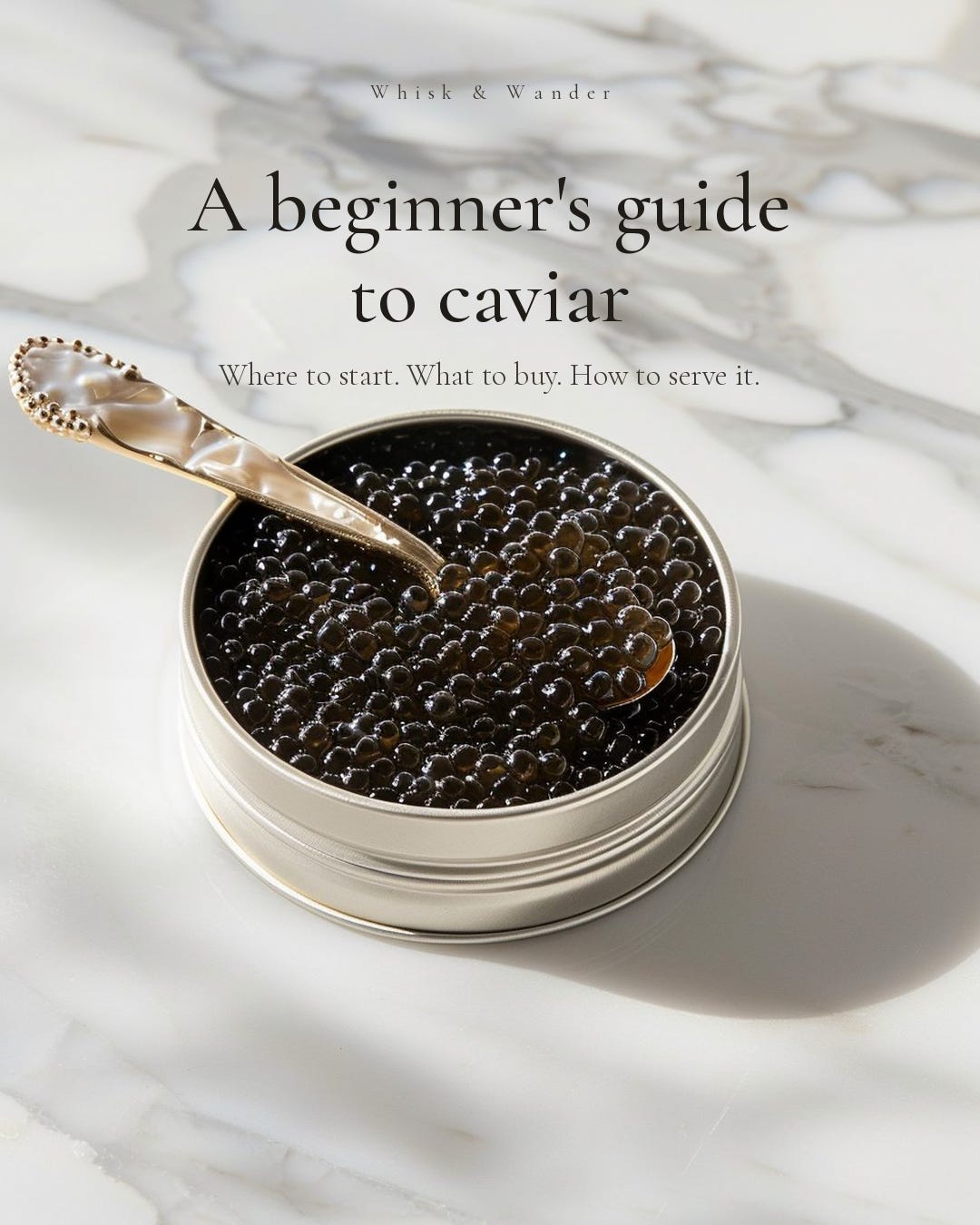
Caviar has a reputation problem. Somewhere along the way it became shorthand for inaccessibility — locked behind tuxedos and tasting menus and the kind of gilded dining room where they replace your napkin every time you stand up. The truth is far less precious. It is a tiny, salty, extraordinary ingredient. It belongs on a Tuesday potato chip just as much as it belongs in a candlelit restaurant.
I started buying it at home a few years ago and never looked back. A small tin, a chilled spoon, a glass of something cold — it changes the temperature of an evening without changing very much else. If you have been curious but unsure where to start, this is for you.
Here is everything I wish someone had told me when I bought my first tin.
Caviar vs. Roe — the quick version
Caviar is technically the salt-cured roe of sturgeon, and only sturgeon. Everything else — salmon, trout, whitefish, paddlefish — is roe. Both are delicious. Both have a place. The difference matters mostly for pricing and for understanding what you are actually buying.
If a label says “salmon caviar,” it is roe. That is fine, that is even great, but it is not the same product as Osetra from a sturgeon farm and it should not cost like one.
The types you will actually see
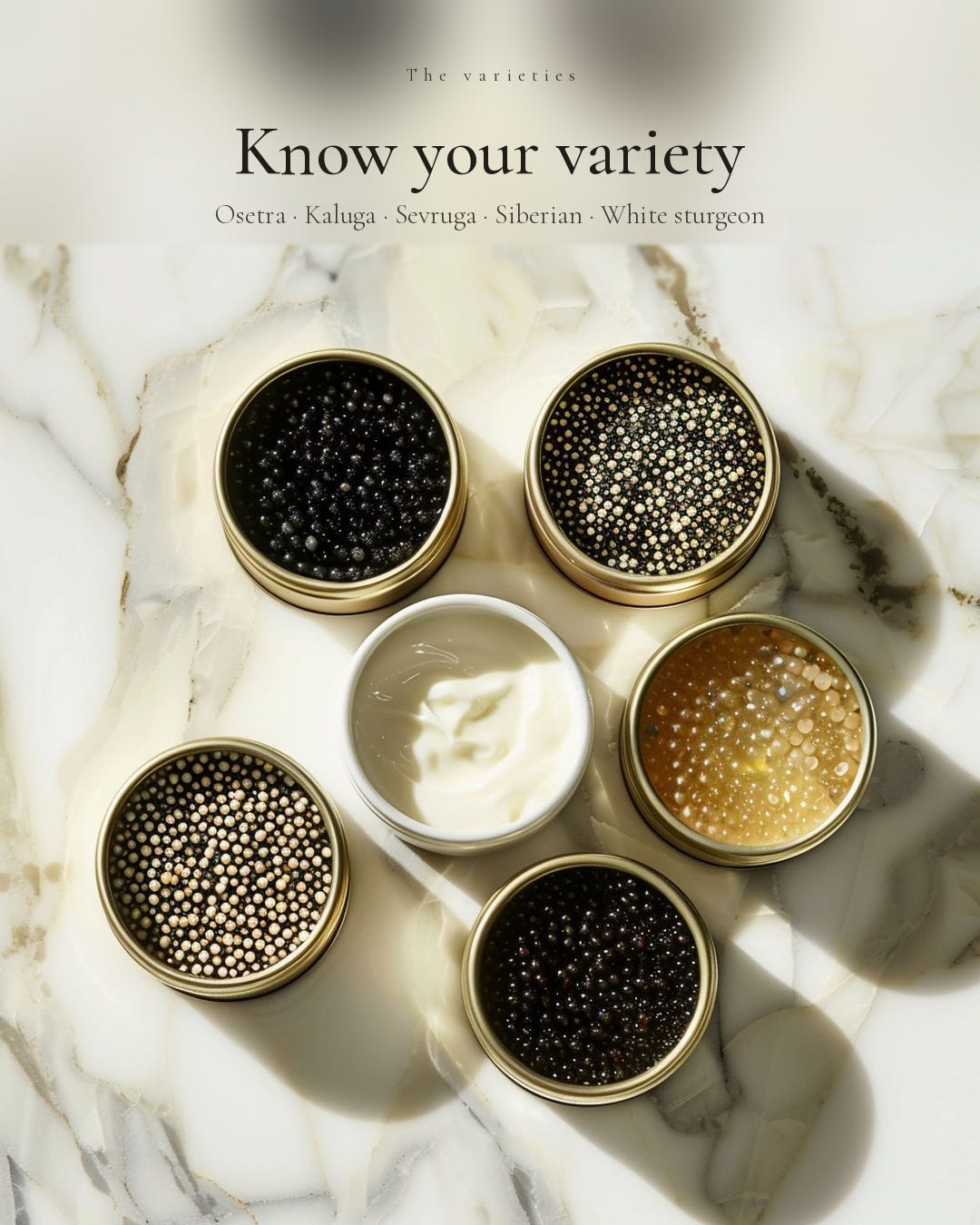
A handful of varieties make up most of what you will encounter at a good retailer. These are the ones worth knowing.
OSETRA — medium grain, buttery, nutty, a little briny. The most beginner-friendly of the classic sturgeon caviars and the one I order most often.
KALUGA HYBRID — large pearl, smooth, rich, slightly creamy. Often described as the closest legal alternative to true Beluga, which is banned for import in the United States.
WHITE STURGEON — farmed in California. Clean, fresh, briny — less buttery than Osetra, with a great pop. ROE Caviar is built on this variety and it is excellent.
SEVRUGA — smaller grain, more intense flavor. Sharper, brinier, more old-world.
SIBERIAN STURGEON — mild and approachable. Smaller pearl, often more affordable, a smart entry point.
PADDLEFISH and HACKLEBACK — wild-caught American varieties. Not technically caviar by strict definition (they are not sturgeon), but treated like it. Earthy, distinctive, and often a fraction of the price.
Where to buy your first tin
The smartest move when you are starting out is a tasting set rather than a single tin. You get a few small portions instead of one larger one, and you learn what you actually like before committing to fifty grams of something you only sort of love.
A few I would point you toward:
CAVI (Eat Cavi) — the Beginner Tasting Kit is the easiest entry point I have come across. Four 15-gram tins, plus crème fraîche, Torres chips, a mother-of-pearl spoon, and a tin opener — basically a caviar flight, made casual. They ship overnight Monday through Thursday.
The Caviar Co. — a women-owned San Francisco brand with a beautiful Variety Flight of three caviars served alongside the right accompaniments. Sustainable sourcing, thoughtful gifting, and a brand identity I keep coming back to.
ROE Caviar — sustainably farmed American white sturgeon caviar from California. The Chef’s Pairing set bundles the caviar with their ROE Bites, crème fraîche, and long-sliced smoked salmon. Polished, considered, a beautiful first impression.
Marky’s — three tasting sets at three price points. The Essential Set is your starter. The Curated Set steps up to four sturgeon varieties. The Grand Set adds Beluga Hybrid and Sevruga for the deeper dive.
Petrossian — the grand dame. Their Caviar Tasting at Home set lets you compare three Petrossian classics side by side — Royal Ossetra, Daurenki, and Persicus. Worth saving for a real occasion.
How much to buy
A standard rule of thumb is one ounce — about thirty grams — per person for a generous tasting. That is a real serving, not a garnish. Half an ounce per person is plenty if caviar is one element on a larger snack plate.
If it is just you and one other person and you want a real moment, fifty grams is a beautiful place to start.
The rules of serving (there are few)
KEEP IT COLD — caviar lives between zero and four degrees Celsius. Never let it sit out at room temperature. If you are serving it for a while, set the tin in a small bowl of crushed ice.
NO METAL — metal spoons impart a subtle but real metallic flavor. Use mother-of-pearl, ceramic, glass, or even plastic. A good caviar tin opener is a small luxury worth owning.
DO NOT PILE IT — the eggs are delicate. Spoon, do not scoop. A small mound is more elegant than a heap.
OPEN AND EAT — once a tin is open, you have three to four days, max. Treat it like a fresh oyster, not a pantry item.

What to put it on
The classic combinations are classic for a reason.
BLINI — small, tender, slightly tangy buckwheat pancakes. Warm them gently. They are almost neutral, which is the point.
POTATO CHIPS — a dressed-down hosting trick I will use forever. A thick, salted kettle chip with crème fraîche and caviar is one of the most generous appetizers you can serve.
SOFT-BOILED EGGS — just-set yolk, a spoonful of caviar, a torn piece of toast. Breakfast becomes a celebration.
CRÈME FRAÎCHE — always. The slight sourness softens the salt and lengthens the finish.
CHIVES, FINELY MINCED — a clean, bright note that wakes up the whole bite.
A few things to avoid
Do not pair caviar with anything strongly acidic or aggressively garlicky on the same bite. Lemon is fine in small doses, but a heavy squeeze will overwhelm the delicate flavor you are paying for.
Do not freeze it. Texture goes first, then flavor.
Do not overthink it. The biggest mistake new caviar buyers make is treating the experience like an exam. It is just a wonderful little ingredient. Open the tin, pour something cold, and enjoy yourself.
Up next
Once you know what to buy and how to serve it, the next question is what to drink with it. Champagne is the safe answer. It is not always the right one. The next post in this series breaks down exactly which spirits, wines, and bottles to pour with each caviar variety — including the Russian-tradition pairing most Americans skip and the unexpected white wine that holds its own against Osetra.
Subscribe so you do not miss it.
© 2026 Audrey Campbel

l